The Noble Oak Bourbon Cargo Theft: Inside the $500,000 Philadelphia Heist and What It Reveals About America’s Freight Fraud Crisis
Nearly 11,000 Bottles Vanished in Broad Daylight
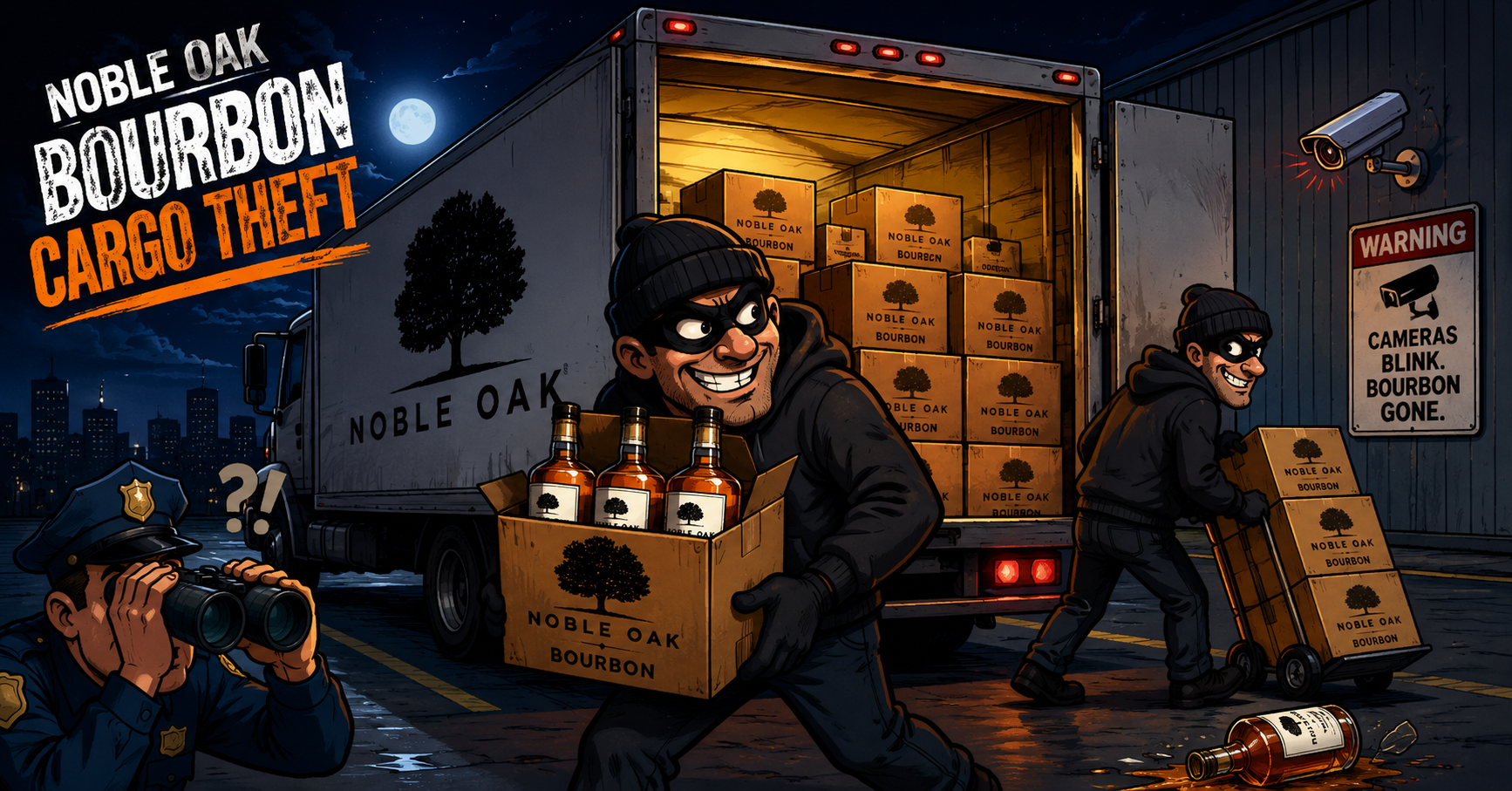
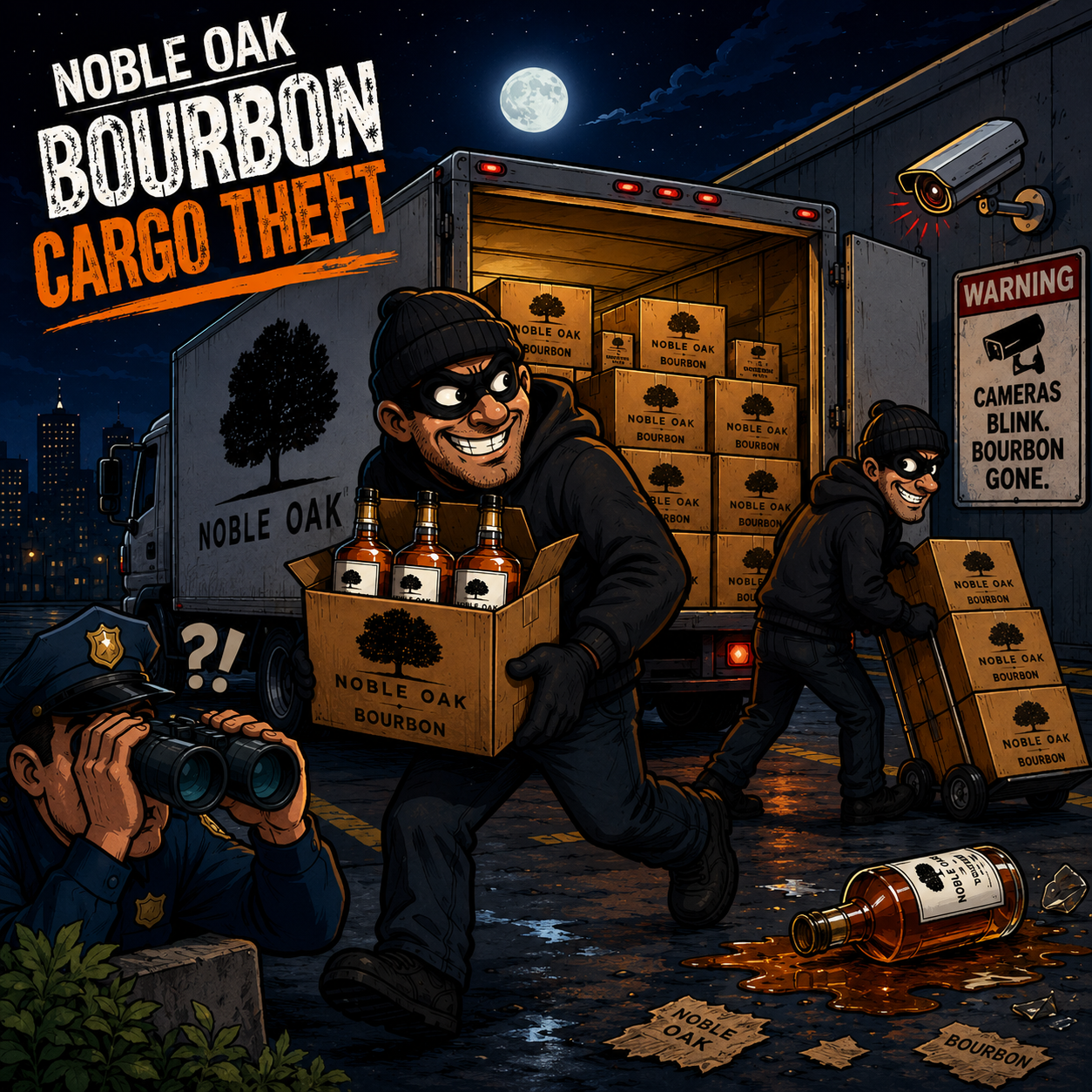
On the afternoon of June 5, 2026, thieves walked away with roughly 1,800 cases of Noble Oak Bourbon — about 10,800 bottles — from a Philadelphia warehouse in a matter of hours. The load was worth an estimated $500,000, and the people who took it never had to break a lock, cut a fence, or hot-wire a trailer. The theft happened at the American Supply warehouse at 2411 N. American Street sometime between 1 and 3 p.m., and the company that owns the brand has called it a coordinated operation carried out in plain sight.
The Noble Oak bourbon theft has since become one of the most talked-about cargo crimes of 2026, not because of its size — plenty of freight thefts involve larger dollar amounts — but because of how it was pulled off. This wasn’t a smash-and-grab. It was a con.
Here’s everything currently known about the case, how the scheme worked, and why alcohol brands, warehouses, and freight brokers across the country are paying close attention.
What Happened, Step by Step
The bourbon belonged to A21 Wine & Spirits, operating under parent company Apogee 21 Holdings, Inc. A21 Wine & Spirits acquired the Noble Oak brand from the Scottish spirits company Edrington in 2024, and the stolen shipment represented a significant chunk of the brand’s newly consolidated inventory.
According to public statements from the company, the shipment was scheduled for a legitimate pickup that day. Instead of the real carrier showing up, individuals arrived first, posing as the authorized trucking company sent to collect the freight.
Apogee 21 CEO Mark Newman has described how the deception unfolded: the suspects presented what appeared to be a valid driver’s license and a purchase order number, and warehouse staff verified that information through a logistics provider before releasing the shipment. In other words, the fraud didn’t just fool a distracted employee — it passed a verification step that was designed to catch exactly this kind of scam.
A separate account of the incident adds a telling detail: when warehouse workers called the trucking company to confirm a truck had been dispatched, the company confirmed a truck was indeed en route — because the thieves had already intercepted or spoofed that confirmation process, and by the time the real truck showed up, the bourbon was gone.
By the time anyone realized something was wrong, 18 pallets of bourbon — each case holding six bottles — had already left the building. Officials said the total came to 10,800 bottles.
“A Coordinated Cargo Theft Operation”
Company officials didn’t mince words about what they believe happened. A21 Wine & Spirits described it as a “coordinated cargo theft operation carried out in broad daylight.” In a statement, the company added that the crime showed clear signs of inside knowledge: “The theft involved a significant quantity of premium bourbon from our newly acquired brand, Noble Oak, and appears to have been executed with knowledge of logistics operations and product movement schedules.”
That phrase — “knowledge of logistics operations and product movement schedules” — is the crux of the case. Whoever planned this theft knew when the shipment was leaving, where it was going, and how to make themselves look like the people who were supposed to pick it up.
Rob Koch, chief operating officer of Apogee 21 Holdings, has publicly described how the thieves deceived warehouse employees into believing the pickup was legitimate and authorized. Despite the financial hit, Koch pointed to the company’s tree-planting program tied to every bottle sold as a small silver lining amid an otherwise stressful ordeal.
Where the Investigation Stands
The theft has been reported to multiple agencies, including the Philadelphia Police Department and the FBI. As of the most recent public updates, no arrests have been announced and the stolen bourbon has not been recovered.
Investigators have not disclosed several key details that would help explain how the scheme was engineered: how the suspects obtained the shipment’s specific paperwork and timing, whether the load was targeted weeks in advance, or how many people were involved in planning versus executing the theft. These unanswered questions matter, because they would reveal how organized theft rings are exploiting weak points in freight identity verification more broadly.
A21 Wine & Spirits has said it is fully cooperating with law enforcement and is treating the case as a serious criminal matter.
Why This Theft Is Different From a Typical Truck Hijacking
Most people picture cargo theft as something violent or physical — a hijacked truck, a cut padlock, a driver held at gunpoint. The Noble Oak case represents a different and rapidly growing category: strategic cargo theft, sometimes called theft by deception.
The FBI defines it plainly: strategic cargo theft happens when criminals use fraud — fake paperwork, impersonated carriers, compromised business accounts — to trick a legitimate business into voluntarily handing over freight, rather than stealing it by force. It’s a confidence scheme wearing a trucking company’s logo.
This distinction matters because it changes who needs to be on alert. A locked trailer and a security camera won’t stop a strategic theft. The vulnerability isn’t in the parking lot — it’s in the paperwork, the phone verification process, and the trust placed in a purchase order number.
Strategic Cargo Theft Is Exploding Nationwide
The Noble Oak heist didn’t happen in a vacuum. It’s part of a documented, accelerating trend across U.S. supply chains.
- Fictitious pickups have surged nearly ninefold in three years. Insurance data shows fictitious pickup schemes averaged just 66 incidents per year between 2012 and 2022 — then jumped to 576 incidents in a single year by 2023.
- Identity fraud in freight is up sharply. CargoNet recorded a 438% increase in identity fraud complaints tied to cargo theft in a recent year, as criminals increasingly steal or fabricate a real carrier’s USDOT and MC numbers to book and intercept loads.
- Total cargo theft losses hit roughly $725 million in 2025 — a 60% jump from the year before — even though the total number of incidents barely moved. According to Verisk CargoNet, that’s because criminal groups have become more selective, deliberately chasing high-value loads instead of opportunistic, low-value theft. The average stolen shipment was worth nearly $274,000, up 36% year over year.
- Deceptive pickup schemes kept climbing into 2026. Supply chain security firm Overhaul reported that even as overall cargo theft incidents declined slightly in the first quarter of 2026, deceptive pickup schemes continued to rise.
Alcohol and beverages sit squarely in the crosshairs. Industry risk analysts have flagged liquor alongside electronics, pharmaceuticals, and luxury goods as one of the top categories being targeted specifically because it’s high-value, easy to resell, and hard to trace once it enters secondary markets.
Why Bourbon Is a Prime Target for Organized Theft
Bourbon theft isn’t new, but it has become increasingly attractive to organized crime for a few concrete reasons:
It holds its value and moves fast. Premium and allocated bourbon can resell close to — or above — retail price through informal channels, bars, restaurants, and private collectors who don’t always ask hard questions about where a large, discounted lot came from.
It’s easy to disguise. A pallet of bourbon looks like any other pallet of bourbon. Unlike a car or a piece of electronics with a serial number, bottles of liquor are difficult to trace back to a specific stolen shipment once they’re separated from their original cases.
Distribution networks are fragmented. The three-tier alcohol distribution system in the U.S. — producer, distributor, retailer — creates a lot of handoff points. Each handoff is a moment where a fraudulent actor could plausibly insert themselves if they have the right-looking paperwork.
Warehouses move fast on tight schedules. Freight operations are built for speed and volume, not for slowing down to interrogate every purchase order. That operational pressure is exactly what strategic theft rings are engineered to exploit.
Noble Oak’s profile made it a particularly attractive target: it’s a real, established, widely distributed brand — originally launched under Edrington in 2018 and distilled at the well-known MGP facility in Indiana — that had just changed corporate ownership. Brand transitions like an acquisition often mean shifting logistics providers, new staff, and updated shipping protocols, all of which can create short-term gaps that criminals are quick to notice.
What A21 Wine & Spirits Is Asking the Industry to Watch For
Because the stolen bourbon is likely to surface for resale rather than sit in a warehouse somewhere, A21 has issued a public alert asking anyone in the supply chain — and consumers — to watch for specific red flags:
- Large quantities of Noble Oak Bourbon being offered outside normal, authorized distribution channels
- Unusually steep discounts on Noble Oak product
- Online marketplace listings offering large volumes of the brand
- Freight, brokerage, or transportation activity involving newly acquired Noble Oak supply that doesn’t match known, authorized shipments
- Any suspicious storage or handling of large quantities of the product
The company is asking distributors, retailers, bars, restaurants, freight brokers, warehouse operators, and everyday consumers to report suspicious offers directly to law enforcement or to the company.
How Warehouses and Shippers Can Guard Against This Exact Scam
The Noble Oak case is now being used across the freight and logistics industry as a case study in how strategic theft defeats “normal” verification. A few practical takeaways stand out for any business handling high-value freight:
Verification has to go beyond a phone call to a number on the paperwork. In this case, staff did call to confirm the pickup — the problem is that the confirmation itself was compromised. Independent verification should route through a phone number or contact pulled from a trusted internal database, never one supplied by the person or documents in front of you.
Require advance, two-way pickup authorization. Many logistics security experts now recommend a documented handoff protocol: the shipper confirms carrier details directly with the broker or manufacturer days in advance, not at the loading dock in the moment.
Use GPS tracking and geofencing on high-value loads, so that any deviation from an expected route triggers an immediate alert rather than being discovered after the fact.
Vet carriers against their full history, not just a DOT or MC number, since criminal groups increasingly buy or clone the credentials of carriers with clean, established records specifically to appear legitimate.
Run tabletop drills. Several risk consultancies are now advising shippers to simulate fictitious pickup and double-brokering scenarios with warehouse staff so employees recognize the pattern before it happens for real, rather than during it.
Review cargo insurance policy language closely. Standard carrier liability coverage doesn’t always extend to freight that was released to a fraudulent party rather than stolen outright — a gap that’s caught more than one shipper off guard after a strategic theft.
The Bigger Picture: A Supply Chain Under Siege
The Noble Oak bourbon theft joins a growing list of high-profile 2026 cargo crimes that share the same fingerprint: sophisticated, paperwork-driven, and executed with insider-level knowledge of shipping schedules. Security researchers have pointed to a troubling pattern behind these cases — traditional organized crime groups, who once relied on hijacking trucks by force, are increasingly partnering with cybercriminals who can supply the digital reconnaissance needed to pull off a convincing fictitious pickup.
Government and industry are responding. The FBI has issued repeated advisories on the rise of carrier impersonation, phishing-driven load diversion, and fraudulent load postings. The Department of Homeland Security’s Operation Boiling Point continues to target organized cargo theft and retail crime rings. And insurers like Travelers now run dedicated Special Investigations Groups focused specifically on strategic and identity-based cargo theft, having recovered more than $130 million in stolen freight since 2009.
Still, cases like Noble Oak’s demonstrate that even sophisticated, well-established logistics networks remain vulnerable to a scheme built entirely on convincing paperwork and a well-timed phone call.
Frequently Asked Questions
How much Noble Oak Bourbon was stolen?
Roughly 1,800 cases — about 10,800 bottles — worth an estimated $500,000 were taken from a Philadelphia warehouse on June 5, 2026.
Where did the Noble Oak bourbon theft happen?
The bourbon was stolen from a warehouse operated by American Supply on North American Street in Philadelphia.
How did the thieves steal the bourbon without breaking in?
They allegedly posed as the legitimate trucking company scheduled to pick up the shipment, presenting documentation and a purchase order number that appeared valid enough to pass the warehouse’s verification process. This tactic is known as a “fictitious pickup” or strategic cargo theft.
Who owns Noble Oak Bourbon?
Noble Oak is owned by A21 Wine & Spirits, a subsidiary of Apogee 21 Holdings, Inc., which acquired the brand from Edrington in 2024. Noble Oak was originally launched by Edrington in 2018.
Has the stolen bourbon been recovered, or has anyone been arrested?
As of the most recent public updates, no arrests have been announced and the stolen inventory has not been recovered. The case remains under investigation by the Philadelphia Police Department and the FBI.
What should I do if I’m offered a large quantity of discounted Noble Oak Bourbon?
Treat it as a red flag, especially if it’s coming from an unauthorized seller, an online marketplace, or a source outside your normal distribution channel. Report the offer to local law enforcement or directly to A21 Wine & Spirits.
Is bourbon theft becoming more common?
Yes. Liquor and beverages are now considered high-value, high-resale targets for organized cargo theft rings, alongside electronics, pharmaceuticals, and luxury goods. Total U.S. and Canadian cargo theft losses reached an estimated $725 million in 2025, driven by increasingly selective, high-value targeting.
This article reflects publicly available statements from A21 Wine & Spirits, Apogee 21 Holdings, law enforcement sources, and industry reporting as of early July 2026. Details of the ongoing investigation may change as new information becomes available.