Eagle Rare vs. Blanton’s
Which One Earns Your Pour?
Same distillery. Different philosophy. One carries a 10-year age statement and a $45 price tag. The other carries one of bourbon’s most iconic bottles and a price tag nearly double that. Here’s what the scores say.
See the Verdict ↓Last updated: July 2026 · Whiskey Consensus Editorial Team
Eagle Rare and Blanton’s share a distillery, a single-barrel designation, and a reputation that far exceeds their retail availability. Beyond that, they’re genuinely different whiskeys — different mashbills, different age philosophies, different price points, and different reasons people hunt for them. This guide breaks down the differences that actually matter, using WC scores across tasting categories and real-world value context.
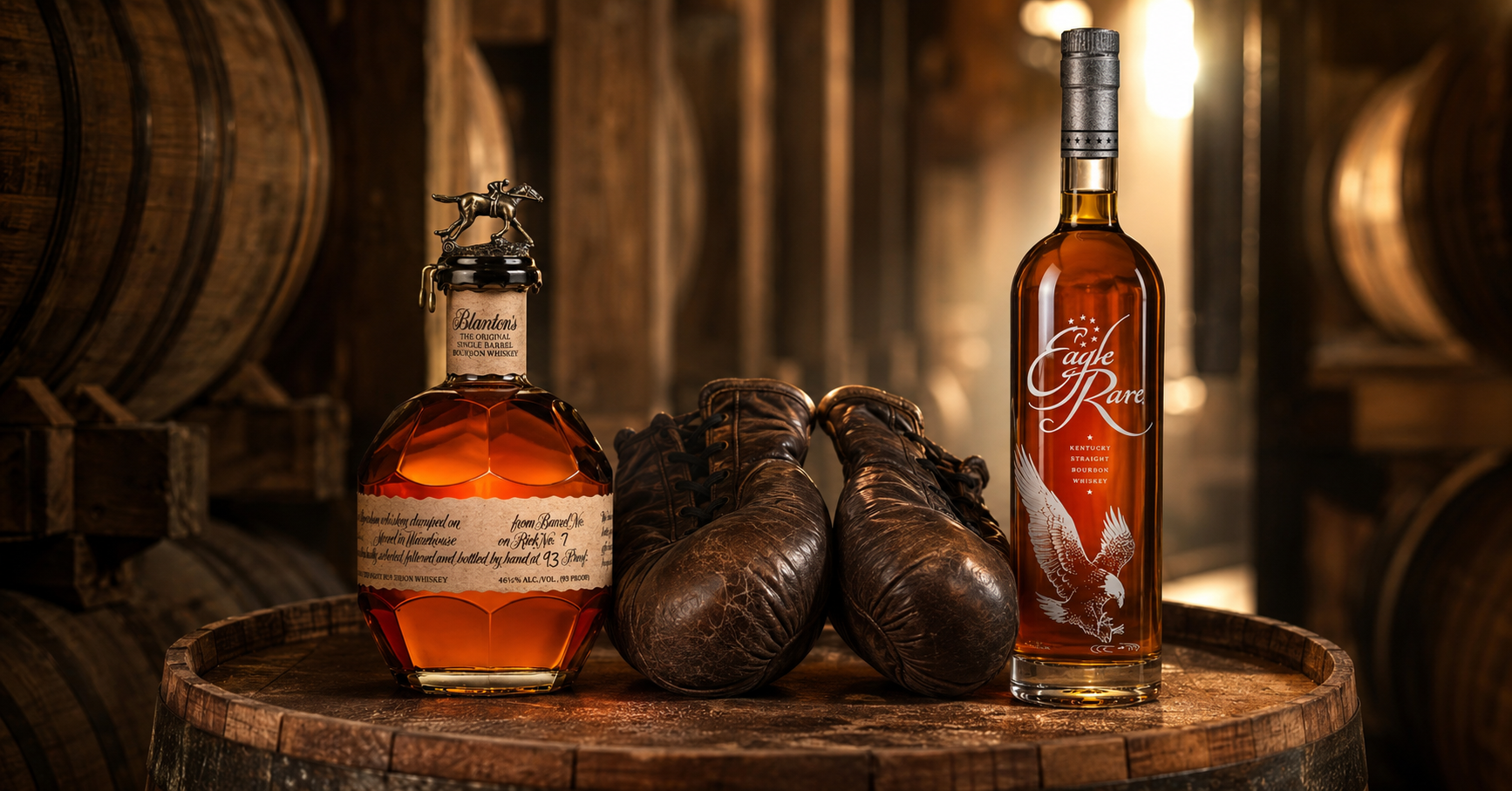
At a Glance
| Eagle Rare 10 Year | Blanton’s Original | |
|---|---|---|
| Distillery | Buffalo Trace | Buffalo Trace |
| Age | 10 years (stated) | ~6–8 years (unstated) |
| Proof | 90 proof (45% ABV) | 93 proof (46.5% ABV) |
| Mashbill | Low rye (BT Mashbill #1) | Higher rye |
| MSRP | ~$45 | ~$80 |
| Secondary Market | $70–$120+ | $150–$250+ |
| WC Score | 8.3 / 10 | 8.0 / 10 |
| Availability | Allocated | Highly allocated |
WC Scores
Both bottles were evaluated across five categories — Nose, Palate, Finish, Complexity, and Value — on a 1–10 scale, then averaged to produce the overall WC Score.
Eagle Rare 10 Year: Nose 8.0 · Palate 8.1 · Finish 8.2 · Complexity 8.2 · Value 8.8 — the value score is the standout, reflecting how much age and quality you get for $45.
Blanton’s Original: Nose 8.1 · Palate 8.0 · Finish 8.0 · Complexity 8.0 · Value 7.9 — strong across the board, with value being the only drag given current market pricing.
10 Year
Original Single Barrel
Tasting Notes
Same Kentucky water, same rickhouses, meaningfully different pours. The mashbill difference — Eagle Rare’s low-rye grain bill versus Blanton’s higher-rye recipe — shapes two distinct flavor directions that run all the way from first nosing to the final sip.
Honeycomb, orange peel, caramel, toasted oak, vanilla, dark cherry, baking spice
Honey, brown sugar, vanilla, white pepper, baking spice, toffee, subtle oak
Toffee, honey, vanilla, baking spice, oak, leather, warm earthiness
Approachable and well-balanced — honeycomb sweetness up front, oak and spice settling in on the back end
Vanilla, sweet caramel, baking spice, oak char, citrus, light smokiness
Sweet caramel, chocolate, rye spice, tobacco leaf, fresh orange peel; velvety mouthfeel
Brown sugar, vanilla, cinnamon, clove, peppery rye spice, soft oak; long and warm
Complex and layered — rye spice runs through every stage, grounded by sweet caramel and a rich, velvety texture
The Key Difference: Mashbill
Eagle Rare is built on Buffalo Trace’s low-rye Mashbill #1 — the same grain recipe behind Buffalo Trace itself, Benchmark, and E.H. Taylor Small Batch. At ten years, that mashbill produces a bourbon defined by barrel character: deep oak, dark fruit, and a dry leather finish. Blanton’s uses a higher-rye mashbill that introduces more spice, citrus brightness, and floral lift. Neither is objectively better; they’re targeting different palates.
The age gap matters too. Eagle Rare’s guaranteed ten-year age statement means every bottle has had a full decade of barrel contact regardless of which barrel you’re opening. Blanton’s carries no age statement, which gives Buffalo Trace flexibility in barrel selection but means the liquid is typically six to eight years old — noticeably younger in the glass.
Eagle Rare also makes a 12 Year — and it scores higher.
If you can find it, the Eagle Rare 12 Year (95 proof, ~$50) scores 8.6/10 on WC — higher across every category than the 10 Year, with deeper dark fruit, more pronounced oak, and a longer finish. It’s the same mashbill with two more years of barrel work, and the difference is audible in the glass. At a $5 price difference, it’s worth seeking out.
Read the Eagle Rare 12 Year Review →Value: Where the Real Difference Lives
At MSRP, Eagle Rare at $45 is one of the strongest value propositions in allocated bourbon. A 10-year-old single barrel from a top-tier distillery under $50 is genuinely rare, and the quality tracks the price — this isn’t a value pick that punches at its class, it’s a bourbon that belongs several rungs above it.
Blanton’s at $80 MSRP is harder to defend than it used to be. It’s a well-made single barrel with a profile that earns its place on a shelf, but at nearly double the price of Eagle Rare for younger, no-age-statement liquid, the value math gets difficult. And that’s before the secondary market enters the picture: most people who find Blanton’s in the wild are looking at $150–$250 or more. At those numbers, Eagle Rare, E.H. Taylor Small Batch, Four Roses Single Barrel, and several other allocations offer equal or superior quality without the markup. Buy Blanton’s when you find it at retail. Don’t chase it at secondary.
The Verdict: Which Should You Buy?
There’s a version of this answer that depends entirely on what you’re looking for. Here’s how we break it down.
- Best value per dollar from this distillery
- Oak-forward, mature profile you can sip daily
- Guaranteed age statement in every bottle
- A benchmark single-barrel for any home bar
- Scoring blind against bottles 2–3× the price
- Gifting — the bottle and stopper are distinctive
- Collecting the full stopper set (A through Z)
- Higher-rye profiles with citrus and spice
- Showcasing the variation of single-barrel bourbon
- If you find it at MSRP — it’s still a solid pour
Head-to-head on liquid alone, Eagle Rare wins. The 10-year age statement, stronger value score, and more developed barrel character give it the edge in the glass. Blanton’s wins the room — it’s the bottle people recognize, the gift that lands, and the one worth grabbing at retail when you find it. Just don’t let the stopper justify paying double on the secondary market.
Common Questions
Answered from the WC scored review library.
Eagle Rare scores higher overall (8.3 vs. 8.0 on the WC scale) driven largely by a stronger value score — it’s a 10-year-old single barrel at roughly half the price of Blanton’s. In tasting comparisons, both deliver well across Nose, Palate, and Finish. Eagle Rare is preferred for its oak depth and dark-fruit character; Blanton’s for its rye spice, chocolate, and velvety mouthfeel. For everyday drinking and value, Eagle Rare is the stronger pick. For gifting or collecting, Blanton’s iconic bottle gives it a different kind of appeal.
Yes. Both are produced at Buffalo Trace Distillery in Frankfort, Kentucky. Despite sharing a distillery, they use different mashbills — Eagle Rare uses Buffalo Trace’s low-rye Mashbill #1, while Blanton’s uses a higher-rye recipe. That grain bill difference is the primary driver of their different flavor profiles.
Blanton’s retail price is around $80, but secondary market prices regularly reach $150–$250 or more due to limited production and high demand. The premium is driven largely by the collectible bottle and stopper design, its status as the first commercially marketed single-barrel bourbon, and high visibility in whiskey collecting circles — not a significant quality gap over Eagle Rare or comparable single-barrel bourbons.
Both are allocated by Buffalo Trace and difficult to find at MSRP. Blanton’s is generally harder to locate at retail in the United States, though it distributes more broadly internationally. Eagle Rare shows up more consistently at retail accounts on standard Buffalo Trace allocation programs.
Eagle Rare is oak-forward with notes of honey, orange peel, dark chocolate, and leather — a classic aged bourbon profile driven by ten years of barrel contact. Blanton’s is fruitier and spicier, with sweet caramel, chocolate, rye spice, and fresh orange peel, and a noticeably velvety mouthfeel from its higher-rye mashbill. Eagle Rare tastes older and drier; Blanton’s tastes richer and more approachable.
At retail ($80 vs. $45), Blanton’s is a tougher sell than it once was — you’re paying nearly double for younger, no-age-statement liquid. At secondary market prices of $150–$250+, it is not worth it at all. Eagle Rare and other single-barrel bourbons offer equivalent or superior quality at a fraction of the cost. Buy Blanton’s at retail if you find it; skip the secondary markup.
Explore More from the WC Library
Scored reviews, ranked guides, and head-to-head comparisons — built on one consistent standard across 700+ bottles.