The Angel’s Share: The Real Science of Why Whiskey Evaporates During Aging
Last updated July 9, 2026
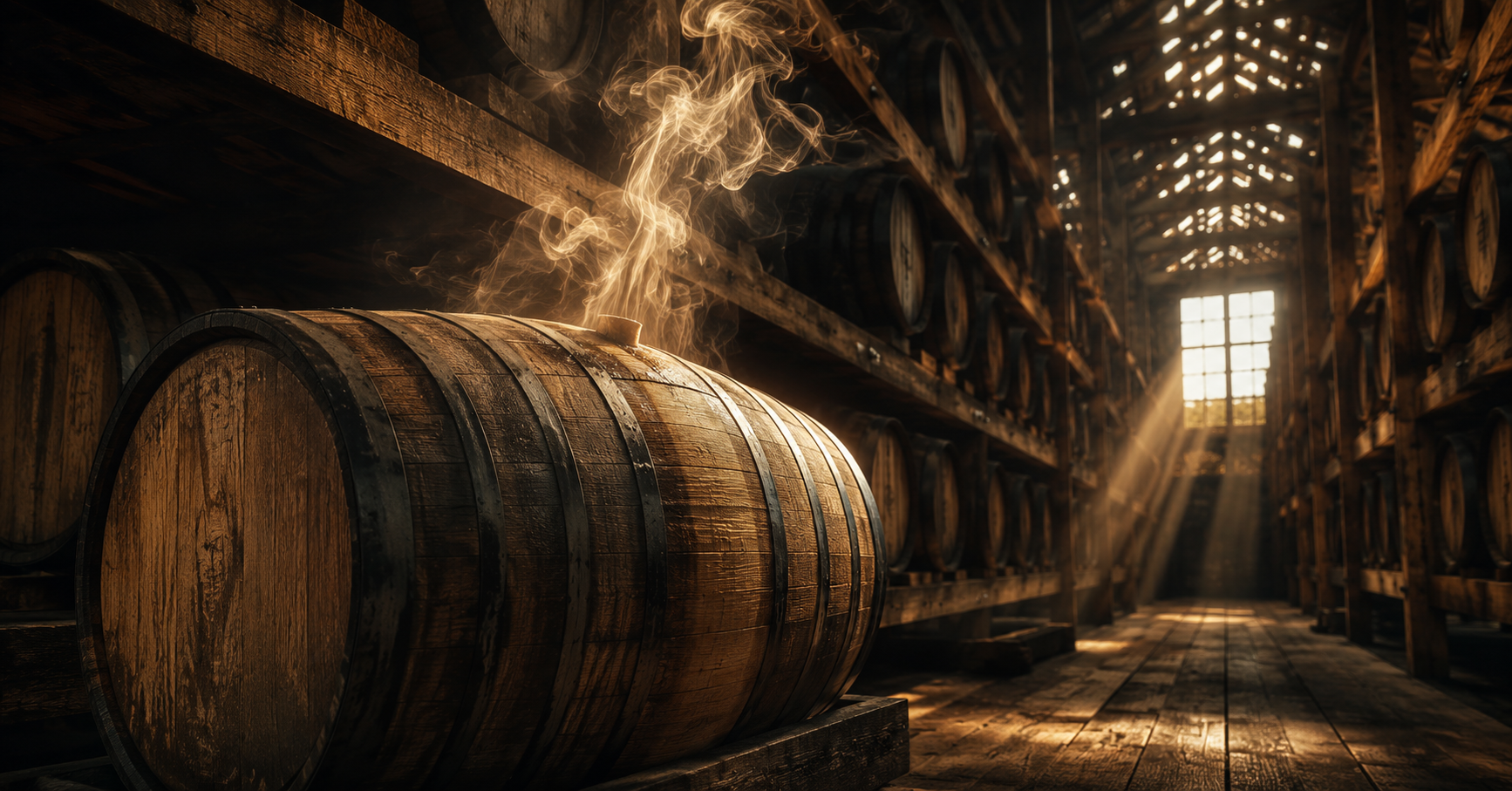
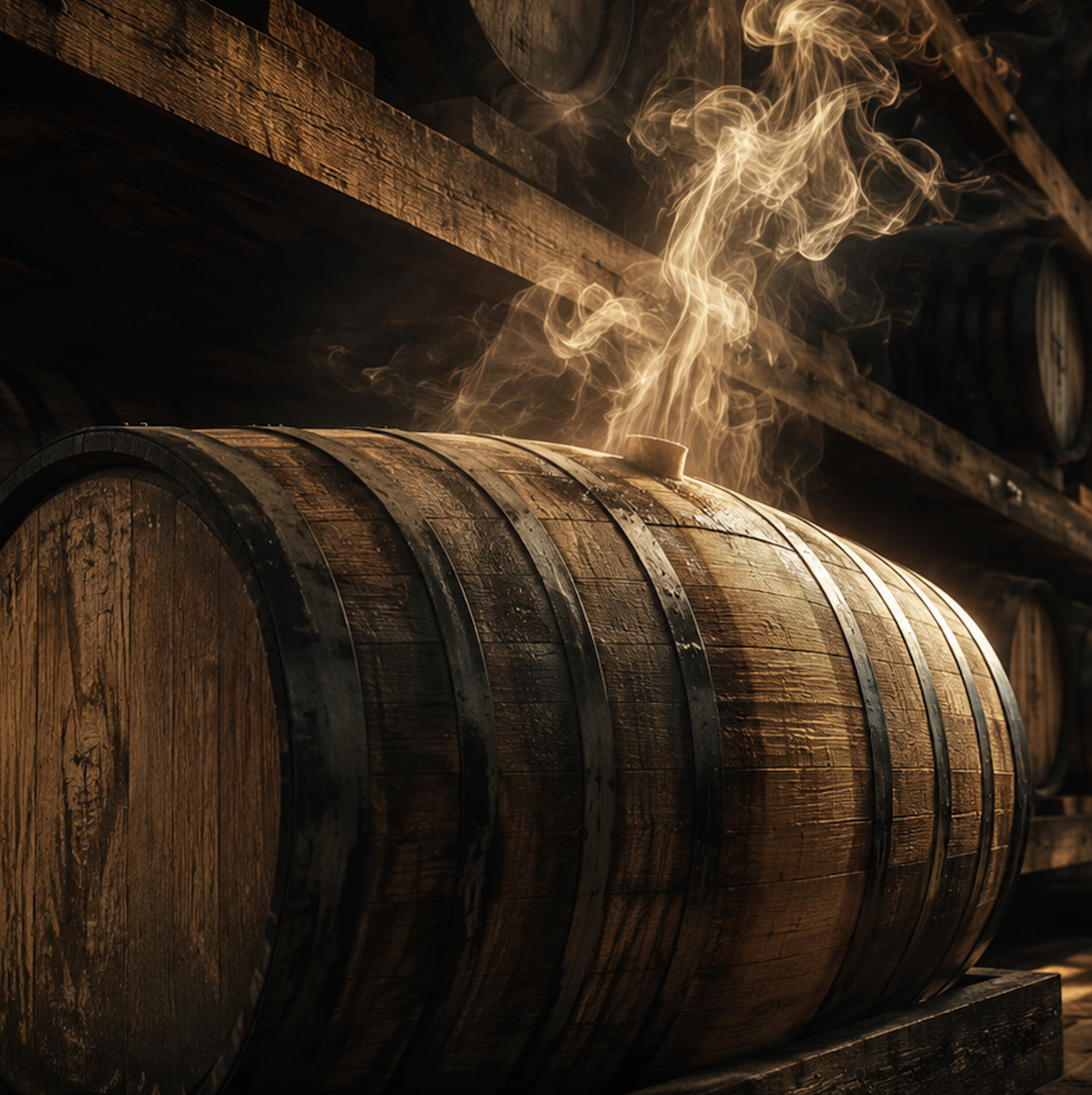
The Angel’s Share is the whiskey that evaporates directly through the pores of an oak barrel during aging. Oak isn’t sealed, it’s porous, so both alcohol and water vapor pass through the wood into the surrounding air. In Scotland this averages about 2% of a barrel’s volume per year; in Kentucky’s hotter, drier rickhouses it can run 4% or higher. Over decades, that adds up to a huge share of what’s ever put in a cask.
If you’ve searched “whiskey that evaporates during aging,” you’ve stumbled onto one of the strangest facts in the entire spirits industry: distilleries plan, from day one, to lose a meaningful chunk of every barrel to thin air. It’s not a leak, a spill, or a flaw in the barrel. It’s built into how whiskey is made, and it happens to every single cask, every single year, on every continent where whiskey is aged.
The term dates back generations, and it’s exactly what it sounds like: distillers joked that angels were sneaking a taste while the whiskey slept in the warehouse. The real explanation is less mystical but arguably more interesting, and it comes down to wood chemistry, humidity, and basic physics.
Why Oak Barrels “Breathe”
A whiskey barrel looks solid, but at a microscopic level it’s full of tiny channels running through the wood grain. As temperature and pressure shift, the liquid inside the cask expands and contracts, pushing into those channels and pulling back out again. Some of that liquid, as both alcohol vapor and water vapor, escapes straight through the wood and into the warehouse air. It’s a slow, continuous exchange, not a single event, and it never fully stops for as long as the whiskey sits in wood.
That constant motion is also part of why barrel aging works at all. As the spirit is drawn in and out of the surface layers of the oak, it picks up compounds from the wood, tannins, vanillin, and sugars caramelized by charring, that give whiskey its color and much of its flavor. The same porous structure responsible for evaporation is what makes maturation possible in the first place.
How Much Whiskey Actually Disappears Each Year?
The commonly cited baseline is about 2% of a cask’s volume per year in a cool, humid climate like Scotland. But that number moves a lot depending on where the barrel is sitting, and it compounds fast over a long maturation.
Kentucky’s numbers run higher largely because of climate. Summer highs in bourbon country regularly climb into the high 80s Fahrenheit, compared to averages closer to the mid-60s in Scotland. Heat accelerates the whole process, both the evaporation and the wood-liquid exchange that drives maturation, so a year in a Kentucky rickhouse can do roughly the work of three years in a Scottish warehouse. A University of Kentucky researcher at the James Beam Institute has estimated that even a barrel with no leaks at all will still lose around 4% a year once you factor in the joints and staves, not just the sealed wood itself.
Why Bourbon Gets Stronger and Scotch Gets Weaker
Here’s the part most people don’t expect: the Angel’s Share doesn’t take alcohol and water in the same ratio everywhere. Which one leaves faster depends entirely on the humidity of the warehouse, and that has a direct effect on proof.
In Scotland’s humid climate, the air outside the barrel is already close to saturated with moisture, so water has nowhere to go. Alcohol, which is more volatile, escapes faster than water does. Over a long maturation, that steadily pulls the ABV down, which is why some 30-year-old Scotch can drop from around 63% ABV at filling to somewhere in the mid-40s by the time it’s bottled.
Kentucky runs the opposite direction. The hot, dry air pulls water out of the barrel faster than alcohol, so proof actually climbs during aging. Whiskey barreled in the low-60s% ABV range can, in rare cases on upper warehouse floors, come out a decade later well above where it started, sometimes even near hazmat shipping thresholds.
Why the Floor of the Warehouse Matters
Traditional Kentucky rickhouses stack barrels seven to nine stories high, and position inside that building has a real effect on the whiskey. Heat rises, so barrels on the top floors sit in a much hotter, drier environment than barrels near the ground, which accelerates both evaporation and flavor extraction. That’s part of why some distilleries rotate barrels between floors during aging, and why certain releases specifically call out where in the warehouse the barrels were resting. Jim Beam’s Booker’s brand, for example, has long been associated with barrels pulled from the warehouse’s “center cut,” the mid-level floors where temperature swings are less extreme than at the top or bottom.
Scotland’s traditional dunnage warehouses work differently. They’re low, stone-walled buildings with earthen floors and only a few rows of barrels stacked on their sides, which keeps humidity high and temperature swings mild. That’s a big part of why Scotch tends to mature more slowly and consistently than bourbon.
The Devil’s Cut: What Doesn’t Make It Out
Not every drop that disappears from a barrel goes into the air. A portion soaks permanently into the wood itself and never comes back out, absorbed into the same porous grain responsible for evaporation. Distillers call this the Devil’s Cut, and unlike the Angel’s Share, it’s not entirely lost: some producers have experimented with extracting it from used barrels through steaming or hot water washes to recover a bit of the flavor and alcohol trapped inside the staves.
The Fungus That Lives on the Angel’s Share
Evaporation on this scale has an unusual side effect: it feeds a fungus. Baudoinia compniacensis, often nicknamed “whiskey fungus,” is a sooty black organism that grows almost exclusively on ethanol vapor. It was first documented near Cognac distilleries in France in the 1870s and wasn’t formally classified as its own genus until 2007. Wherever alcohol-heavy air drifts from an aging warehouse, the fungus can coat nearby trees, fences, cars, and buildings in a dark, crusty film, sometimes stretching over a mile from the source.
It isn’t considered a health hazard, but it has caused real friction between distilleries and their neighbors. Residents near Jack Daniel’s Tennessee warehouses have pursued legal action over cleaning costs and property value, and similar disputes have played out around distilleries in Scotland and Kentucky. The fungus is essentially visible proof of how much alcohol vapor a working rickhouse releases into the surrounding air every year.
Why Distilleries Don’t Just Stop It
Sealing a barrel more tightly, or wrapping it to block airflow, would cut evaporation losses. Some producers have tested exactly that, including barrel-wrapping experiments aimed at controlling proof drift. But full containment isn’t the industry standard, because the same process responsible for the loss is also responsible for the flavor. As liquid volume drops, the remaining whiskey becomes more concentrated, and the ongoing air exchange through the wood drives oxidation reactions that soften harsh notes and build complexity over time. Stop the breathing entirely and you’d also stop much of what makes barrel-aged whiskey taste like barrel-aged whiskey.
That tradeoff is exactly why older whiskey commands higher prices. A cask that starts at 200 liters and ages for decades might yield only a small fraction of that in bottles by the time it’s ready, and every year of aging is also a year of shrinking supply. The price on an old, rare bottle isn’t just paying for time in a warehouse, it’s paying for everything the angels already took.
Frequently Asked Questions
What exactly is the Angel’s Share?
It’s the portion of whiskey that evaporates directly through the porous wood of the barrel while it ages, escaping as alcohol and water vapor into the surrounding air.
How much whiskey is lost to evaporation each year?
Roughly 2% per year in Scotland’s cooler, humid climate, and commonly 4% or more per year in Kentucky’s hotter, drier rickhouses, with even higher rates possible on upper warehouse floors.
Does the Angel’s Share change a whiskey’s proof?
Yes. In humid climates like Scotland, alcohol evaporates faster than water, so proof tends to drop over time. In dry climates like Kentucky, water evaporates faster than alcohol, so proof tends to rise.
Is the Angel’s Share the same as the Devil’s Cut?
No. The Angel’s Share is what evaporates into the air. The Devil’s Cut is the separate portion that soaks permanently into the barrel’s wood and never evaporates or gets bottled.
Why is whiskey fungus connected to the Angel’s Share?
Baudoinia compniacensis, or “whiskey fungus,” feeds specifically on ethanol vapor. It grows on surfaces near aging warehouses because that’s exactly what the Angel’s Share is releasing into the air.
Could distilleries stop the Angel’s Share if they wanted to?
Largely, yes, by sealing or wrapping barrels to block airflow. Most don’t, because the same porous exchange that causes evaporation also drives the flavor and color development that makes barrel-aged whiskey taste the way it does.
This article was compiled from distillery research, published interviews with industry chemists and master distillers, and peer-reviewed work on Baudoinia compniacensis, current as of July 2026.