Eagle Rare vs. Buffalo Trace
Which One Is Actually Worth Your Money?
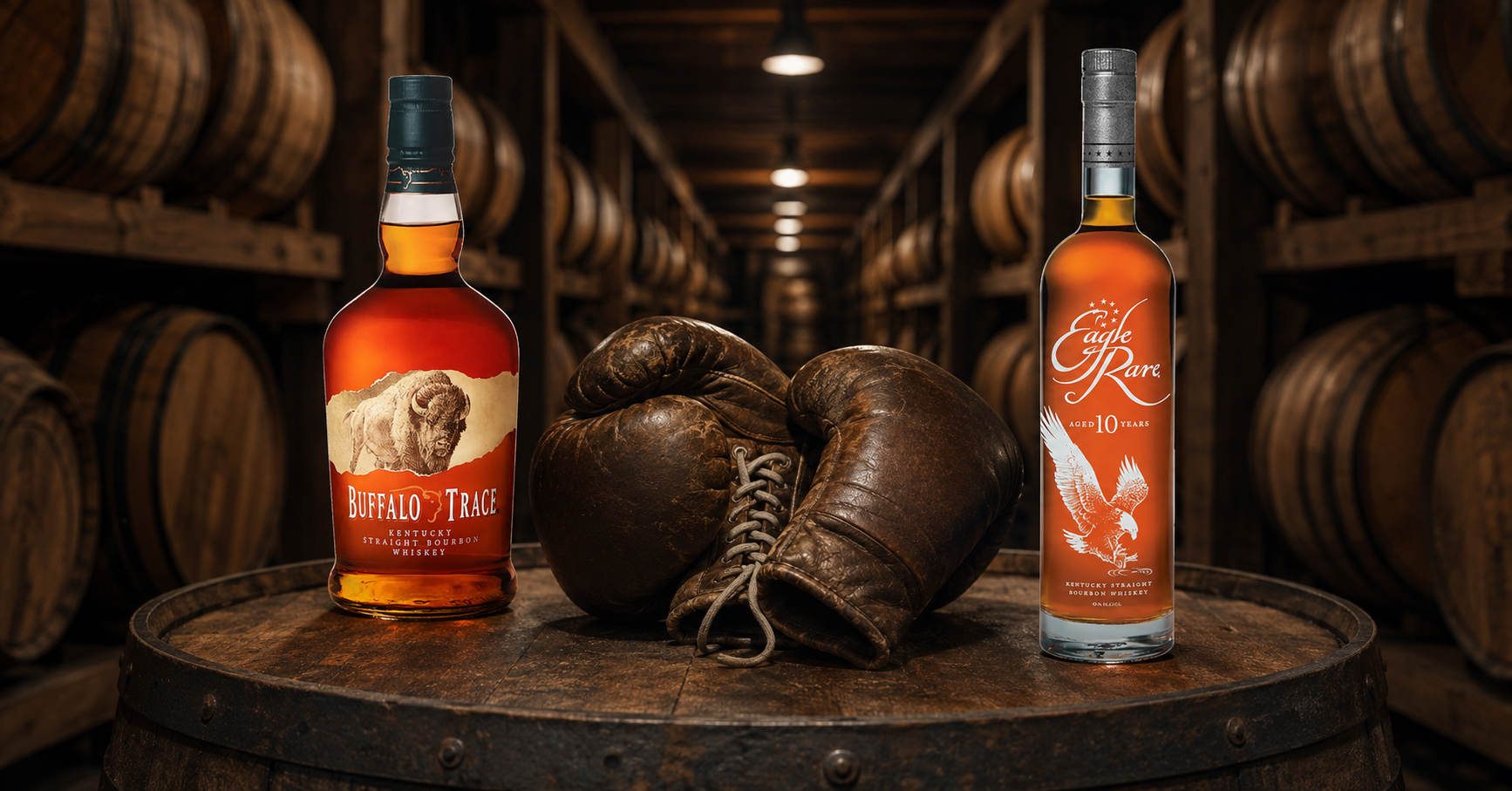
Same distillery. Same mash bill. Same proof. Eagle Rare still costs nearly $18 more than Buffalo Trace — so what exactly are you paying for? Here’s what the scores say.
See the Verdict ↓Last updated: June 2026 · Whiskey Consensus Editorial Team
They come from the same distillery. They share the same mash bill. They’re bottled at the same proof. But Eagle Rare costs nearly $18 more than Buffalo Trace — so what exactly are you paying for?
This is one of the most common questions in bourbon, and it deserves a straight answer. Both bottles were reviewed independently by Whiskey Consensus using our five-category scoring system. Here’s what the numbers say — and what the numbers don’t tell you.
WC Score Breakdown
Each Whiskey Consensus review scores five equally weighted categories on a 10-point scale. Here’s how both bottles compare category by category:
Eagle Rare 10 Year
WC Score: 8.3 / 10Eagle Rare is what happens when Buffalo Trace’s base mash bill gets time — a decade of Kentucky warehouse aging that adds depth, oak character, and a complexity the flagship simply can’t match. The nose opens with floral notes and dried fruit, the palate delivers dark chocolate and caramel, and the finish is long, dry, and distinctly oaky. Ten years of age at 90 proof is a delicate balance, and Eagle Rare gets it right.
Its 8.8 Value score is the standout — our reviewers judged it against bottles in the $50–70 range and found it competes directly. The caveat: finding it at $44.99 MSRP requires either a great relationship with your local retailer or some patience. Secondary market prices are significantly higher.
Read the Full Eagle Rare Review →Buffalo Trace
WC Score: 8.0 / 10Buffalo Trace is the flagship for a reason. Light caramel, vanilla, and soft oak with a clean, accessible finish — it’s approachable, reliable, and genuinely enjoyable at $27. The same mash bill that produces Eagle Rare goes into this bottle, just without the decade of maturation. The result is a lighter, less complex pour that’s easier to drink and significantly easier on the wallet.
The irony: Buffalo Trace can actually be harder to find on shelves than some more expensive bottles. Its reputation and price point have made it one of the most over-allocated bourbons in Kentucky’s portfolio. If you spot either of these at MSRP, buy both.
Read the Full Buffalo Trace Review →The Verdict
Eagle Rare wins on score — 8.3 vs 8.0 — and the 10-year age statement earns that margin. More complexity, better nose, longer finish. If you can find it at MSRP, it’s the clear choice.
Buffalo Trace wins on value and accessibility — at $27, a bottle that scores 8.0 is genuinely difficult to beat. It’s also the better choice for cocktails, mixing, or high-volume entertaining where the nuance of the extra aging would be lost.
The honest answer to “which should I buy?” is: whichever one you can actually find at MSRP. Both are being consumed faster than Buffalo Trace Distillery can produce them. If you see either one on a shelf for $27–$45, it’s a buy without question.
Frequently Asked Questions
Is Eagle Rare better than Buffalo Trace?
Yes, based on Whiskey Consensus scores — Eagle Rare 10 Year earns an 8.3/10 versus Buffalo Trace’s 8.0/10. The difference comes from Eagle Rare’s decade of aging, which adds complexity, a longer finish, and more developed oak character that Buffalo Trace’s younger profile can’t match.
Are Eagle Rare and Buffalo Trace made from the same mash bill?
Yes. Both are produced at Buffalo Trace Distillery in Frankfort, Kentucky using the same Mash Bill #1 — a low-rye recipe. The primary difference is maturation: Eagle Rare is aged a minimum of 10 years, while Buffalo Trace carries no age statement and is typically younger.
Is Eagle Rare worth the extra price over Buffalo Trace?
At MSRP — yes. Eagle Rare at $44.99 scores a 8.8/10 for Value in our review, which means it punches above its price class. The extra $18 over Buffalo Trace buys you a meaningfully more complex, better-developed bourbon. The caveat is finding either bottle at MSRP, which varies significantly by market.
Which is easier to find — Eagle Rare or Buffalo Trace?
Neither is easy to find at MSRP. Buffalo Trace’s low price point and broad appeal make it one of the most over-allocated bourbons in the market. Eagle Rare is allocated as a step-up expression. In many markets, both require retailer relationships or regular shelf checks to find at suggested retail price.
Which is better for cocktails — Eagle Rare or Buffalo Trace?
Buffalo Trace. Its lighter, more accessible profile mixes well and the lower price makes it a better choice when the bourbon is one of several ingredients. Save Eagle Rare for sipping neat or on a single large ice cube — the age-driven complexity is worth experiencing without distraction.