Introduction
The Whiskey Rebellion isn’t just some dusty chapter from a history textbook. It was the moment early America asked itself a big question: Can this brand-new government actually enforce its own laws? And the answer came from an unlikely place: the stillhouses and backwoods communities of the American frontier. What started as a tax on distilled spirits quickly boiled over into protests, armed resistance, and a showdown that shaped both the nation and the legacy of American whiskey.
Post Revolution America and Whiskey
After the Revolutionary War, the United States was broke and scrambling for ways to pay off its debt. Out on the frontier, life looked very different from the bustling eastern cities. Cash was rare, roads were rough, and grain spoiled quickly if you tried hauling it long distances. So farmers did the smart thing. They turned their surplus grain into whiskey.
Whiskey was easier to transport, lasted longer, and could even be traded like money. It wasn’t a luxury so much as a lifeline. For many frontier families, distilling was the difference between making it or not.
Hamilton’s Whiskey Tax
In 1791, Treasury Secretary Alexander Hamilton pushed for a federal excise tax on distilled spirits. His goal was to raise money and show the world that the new federal government had real authority. The problem was the tax was built in a way that hit small frontier distillers much harder than the big coastal operations.
Large distilleries could simply pay a flat fee. Small farmers were charged by the gallon, which was far more expensive. To frontier communities, this felt a whole lot like the unfair British taxes they had just fought a war over.
Why Western Farmers Rebelled
For whiskey makers in western Pennsylvania and nearby frontier regions, the tax felt personal. They were already isolated, had limited political influence, and depended on whiskey to keep their families afloat. The tax cut directly into their livelihood. Many felt ignored by the government that was thousands of miles away both physically and politically.
Their frustrations sounded a lot like their Revolutionary War grievances. If they were being taxed without fair representation, what had they even fought for?
Escalation to Violence
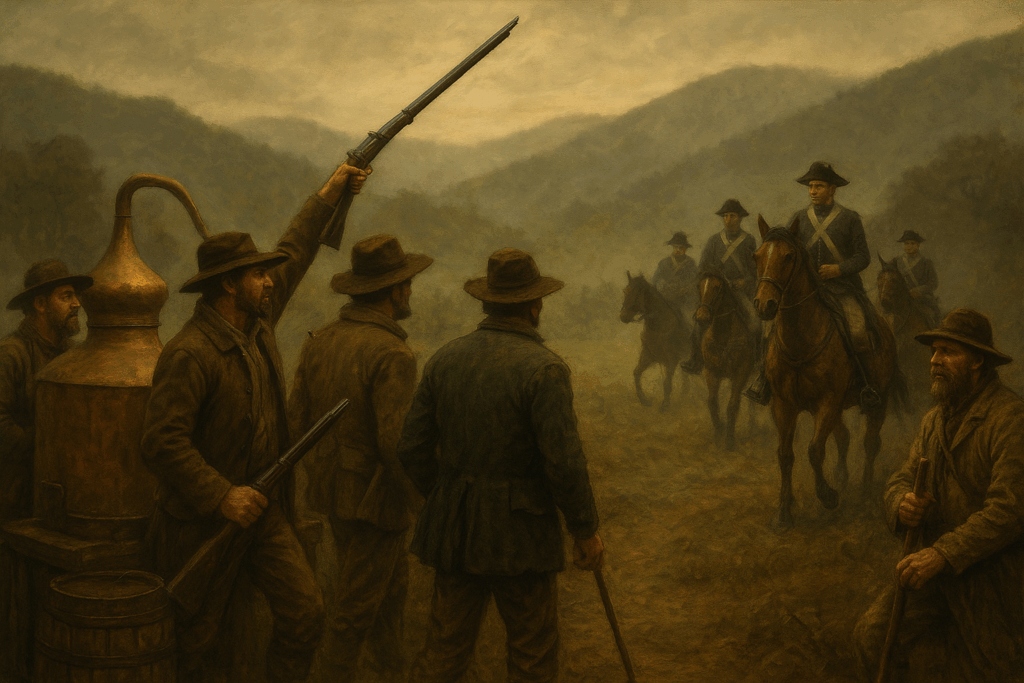
At first, resistance was peaceful. Frontier distillers petitioned, held meetings, and openly refused to register or pay the tax. But as federal tax collectors pushed forward, tempers flared. Collectors were threatened, chased off, tarred and feathered, and had their property destroyed.
Things reached a tipping point in 1794 when armed groups attacked the home of a federal inspector. At that point, protest turned into open rebellion.
Washington’s Response and the March West
President George Washington now faced a huge test. If he ignored the uprising, the Constitution would look weak. But if he responded with too much force, he risked turning citizens against the very government they had just created.
Washington tried negotiation first. When that failed, he did something no other sitting president has ever done. He personally led part of a militia force of nearly thirteen thousand men toward western Pennsylvania to put down the revolt. It was a message that the federal government was not just symbolic. It meant business.
Collapse of the Rebellion
Once the militia marched west, the rebellion fell apart quickly. The sheer size of the force and Washington’s personal involvement made most rebels scatter before any major fighting took place.
Around 150 men were arrested. Only a few were brought to trial. Two were convicted of treason but were later pardoned by Washington. The goal wasn’t revenge. It was stability.
What the Whiskey Rebellion Proved
This moment showed that the United States government had both the power and the will to enforce its laws. At the same time, Washington’s decision to pardon the convicted rebels highlighted a desire for unity rather than destruction.
The Whiskey Rebellion became one of the first real-world tests of the Constitution. It proved that the new nation wasn’t just an idea. It had the strength to stand on its own.
Political Fallout and Party Building
If you think modern political arguments get heated, early America had plenty of its own drama. The rebellion deepened the divide between those who supported a strong central government and those who feared federal overreach.
Hamilton’s supporters believed the government handled things exactly as it should have. Critics, many aligned with the rising Jeffersonian Republican movement, saw the response as heavy-handed and dangerous. These debates helped shape America’s first political parties and influenced national politics for decades.
Legacy for Whiskey and American Identity
The whiskey tax was eventually repealed in the early 1800s, but the rebellion lived on in American culture. For whiskey lovers, this story became a symbol of the independent, rebellious spirit of frontier distillers.
Today, you can find whiskey brands, craft distillers, and bourbon fans still referencing the Whiskey Rebellion. It represents craftsmanship, resilience, and the deep connection between American whiskey and the fight for individual freedoms. It remains one of the biggest reasons whiskey carries a legendary place in America’s story.